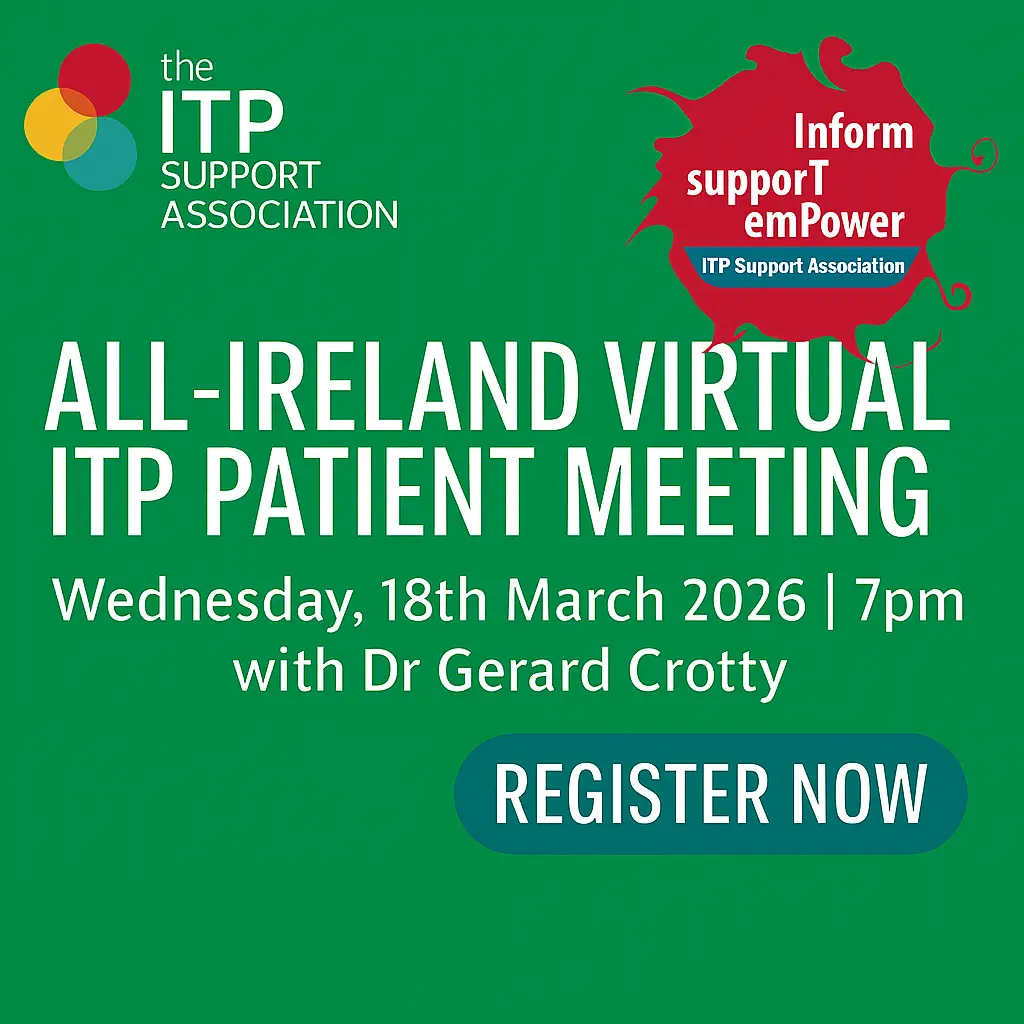
All Ireland Virtual Patient Meeting 18th March 2026
-
by
mervyn
This meeting was a virtual support group session held on 18th March 2026 for the ITP Support Association, with Medical Advisor Dr Gerard Crotty, Patient mentor Rhonda Anderson and mervyn Morgan.. These meetings allow participants to discuss ITP (Immune Thrombocytopenia) experiences and treatments.
The main discussion centred around Jessica’s son, who was diagnosed with ITP at 12 months old and is currently treated with Eltrombopag (Promacta) at 50mg. it was explained that approximately 70-80% of children with ITP go into remission within 12 months.
Owen shared his 16-year journey with ITP, currently managing well on no treatment with platelet counts around 50. Rhonda discussed her experience as a patient mentor and mentioned her recent high platelet count reading of 475-485 following her splenectomy, with Gerard suggesting follow-up testing and potential investigation of iron deficiency.
The group also discussed the availability of generic Eltrombopag in Ireland and the UK, with concerns raised about patients being pressured to switch treatments due to cost differences between branded and generic versions.
Summary
ITP Treatment and Patient Updates
Jessica shared that her 2-year-old son was diagnosed with ITP at 12 months old and has been stable on Promacta (eltrombopag) treatment. Dr. Crotty discussed the use of eltrombopag in children, noting it was the first oral agent in its class with experience in paediatric patients, though he clarified that he treats adults rather than children directly.
Paediatric ITP Treatment Discussion
The group discussed medication forms for treating ITP in children, with the parent explaining that their child receives medication as powder “sprinkles” rather than crushed tablets. Mervyn suggested contacting the Platelet Disorder Support Association (PDSA) in America for additional information and resources. The discussion also touched on the prognosis for paediatric ITP, with Dr Crotty noting that approximately 70-80% of cases in the UK and Europe go into remission within 12 months, though this remains early to determine for the parents child’s specific case.
Paediatric Medical Resources Discussion
Mervyn recommended Jessica should visit PDSA.org to explore paediatric medical resources and mentioned an upcoming conference in Salt Lake City in July.
The group discussed the importance of being cautious about online medical information, with Dr Crotty and Rhonda warning about miracle cures and the need to rely on reputable sources like peer-reviewed journals and established medical associations.
ITP Management and Treatment Updates
Owen shared his 16-year experience managing ITP, with his platelet count currently stable around 50 for the past 10 years. Dr Crotty explained that while a count of 50 is generally acceptable for most general surgery, it may not be sufficient for procedures like epidurals or spinal anaesthesia, recommending higher counts of 75-80 for such cases. Dr Crotty noted that treatment approaches have evolved, with current guidelines focusing on maintaining safe, stable platelet counts rather than aiming for normal levels, particularly to avoid side effects from immunosuppressive treatments.
Platelet Count Management Discussion
Owen shared his experience with platelet count fluctuations during high-dose prednisolone treatment over 18 months, describing it as a “real roller coaster” before stabilizing without further treatment. Dr Crotty explained that current guidelines recommend reducing steroid doses and stopping them altogether at around 6 weeks, noting that newer alternatives like Eltrombopag are now available. Rhonda mentioned her own history with a splenectomy in 2000 and asked Gerard about the appropriate interval for follow-up blood tests after her recent high platelet count reading of 475-485.
ITP Patient Treatment Discussion
The meeting focused on discussing platelet count changes in ITP patients and generic drug availability. Gerard explained that while Rhonda’s platelet count had increased to 485 from a typical range of 300s, this could be due to infection, inflammation, or physical exertion, and recommended checking for underlying conditions like iron deficiency. Mervyn raised concerns about patients being pressured to switch from branded to generic Eltrombopag due to significant cost differences, noting that some patients experienced gastrointestinal issues after switching. The group discussed plans to survey patients about this issue and present findings at an upcoming ITP research day in London.
You may download a complimentary copy of the Shared Decision-Making document from the ITP Support Association website at https://bit.ly/3lNsdKe. The ITP Discussion Guide is also available for download at https://bit.ly/3RlOiye. For hard copies of these documents, please email your details to info@itpsupport.org.uk. To become a member of the ITP Support Association, please visit https://itpsupport.org.uk/join-the-itp-association/. For additional information, refer to our main website: www.itpsupport.org.uk.